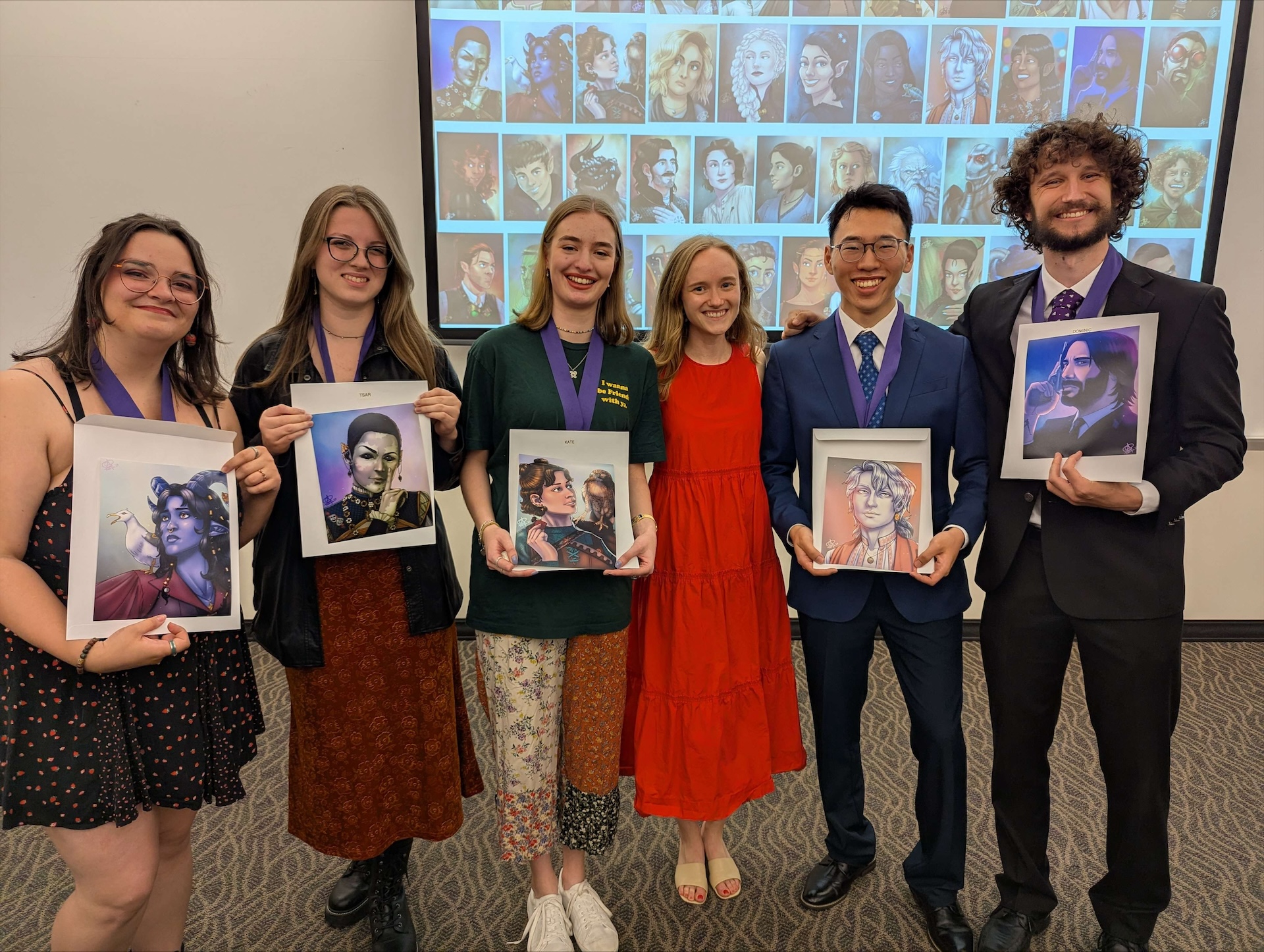
Not every student arrives at college knowing where they belong. For some, the path to connection runs through lecture halls and campus events. For others, it runs through a twenty-sided die. Since 2019, TCU’s Supportive Gaming Community (SGC) has been creating that path for students who might otherwise struggle to find their footing, offering a space built not just on shared interests, but on genuine belonging.
Founded as one of the Counseling & Mental Health Center’s Peer Support Communities, the SGC centers on tabletop role-playing games like Dungeons & Dragons as a vehicle for something much larger: helping students build healthy relationships, practice empathy and problem-solving, and discover strengths they may not have known they had. The games are the draw, but the community is the point.
For students who feel like they don’t quite fit the image of a “typical” college experience, the SGC offers something rare: a room full of people who are genuinely glad they showed up. Gatlin Adams, a graduating senior in engineering, put it plainly: “The SGC has become a hub of socialization and entertainment for me at TCU. It has led me to meet many new friends.”
At the center of each game is a Game Master (GM), a staff or faculty member who serves as both storyteller and steward of the group’s experience. It’s a role that sounds niche but draws in people across the university. Justine Grace, an Academic Advisor for the John V. Roach Honors College, describes her introduction to the program with characteristic warmth: “I like to say I was gently ambushed. I had expressed interest in games like Dungeons & Dragons but had never played. Coincidentally, the SGC was in need of a GM. So, the stars lined up with the opportunity meeting my interest.” What made the decision easy, she says, was recognizing that what the program was trying to do aligned closely with why she got into advising in the first place.
Prior gaming experience is welcome but not required. The SGC trains new GMs from the ground up, whether they’ve been running campaigns for years or have never opened a rulebook. The focus isn’t on technical mastery; it’s on creating an environment where students feel safe, seen, and encouraged to take up space. For Grace, the most meaningful part of the role has less to do with the game itself than with what happens around the table over time. “Students, sometimes for the first time, are in a room with people who share interests with them. Who see them. Being a part of those moments is incredibly rewarding.”
Students feel the difference. Cora Van Y, a creative writing major and SGC participant, describes the community’s culture as something intentionally cultivated and carefully maintained “What sets the SGC apart from other clubs is that it’s so focused on creating a safe environment. The SGC specifically works on making me feel like I can get into the roleplay, be silly, be emotional, and really put a piece of myself into my character and trust that my GM won’t throw that away.” That trust, she adds, extends beyond the GM to every person at the table, where “everyone is just as emotionally invested and willing to work together to make our stories better.”
The GM’s role, then, is as much about mentorship as it is about storytelling. Grace describes it as occupying a distinctive space within her broader work at the university: “I am a staff member, but I get to demonstrate investment in these students’ success and well-being as an ambassador of the university. I have the privilege of being a caring adult in their lives, and sometimes that means making sure the stories and the victories they want to tell happen.”
Students recognize and value that investment in concrete ways. Adams describes Grace’s approach to collaborative storytelling “She has a story she’s telling but loves to find ways to tie my character and their own story into hers, many times brainstorming with me on what I want to see my character do and accomplish.” The relationship doesn’t end when the session does, either. GMs attend weekly meetups, stay available for questions, and show up for community events outside of scheduled play.
Van Y points to one small gesture that captures the spirit of the whole program: “Justine has had time set aside for party members to have ‘office hours’ where you can go in and talk about your character, any changes you want to make, or just sit and talk for a bit.” It’s a low-stakes, open-door approach that reflects something the SGC seems to understand intuitively, students don’t always need a formal intervention. Sometimes they just need a consistent adult who is glad to see them.
Grace articulates the broader value of programs like this one with the clarity of someone who has watched it work firsthand, “These programs meet students where they are. They show students we care to meet them where they are, and we are willing to take the time to get to know them and appreciate them for who they are. It provides consistent, meaningful community that, when it works, it works. Students make friends, make connections, and know that there is a place for them on campus.”
The SGC is currently looking for TCU faculty and staff who are interested in becoming Game Masters. New GMs receive full training, mentorship, and ongoing support from experienced facilitators. No gaming background is necessary. Grace’s advice to anyone considering it is straightforward: “I would say do it! I had never played or ran D&D before I joined with the SGC. This experience has been such an unexpected joy and is now an irreplaceable part of my career and life.”
The students agree. Adams frames the invitation in terms any storyteller can appreciate: “Do you have a story to tell, a world you want to share? In the SGC you’ll find a group of people ready and eager to participate in it.” Van Y makes the case even more directly, “DO IT! I love to see the SGC grow, and we need even more people with even more variety in how their creativity works, their personalities, everything.”
At its core, the Supportive Gaming Community is not a gaming club. It is a community-building program that happens to use games as its medium, and it is doing something genuinely hard, helping students feel less alone on a campus of thousands. For faculty and staff looking for a meaningful way to show up for students outside the classroom, the SGC offers exactly that opportunity. Reach out to Joe LeConte at j.leconte@tcu.edu with any questions or curiosity about how to be a part of SGC.